
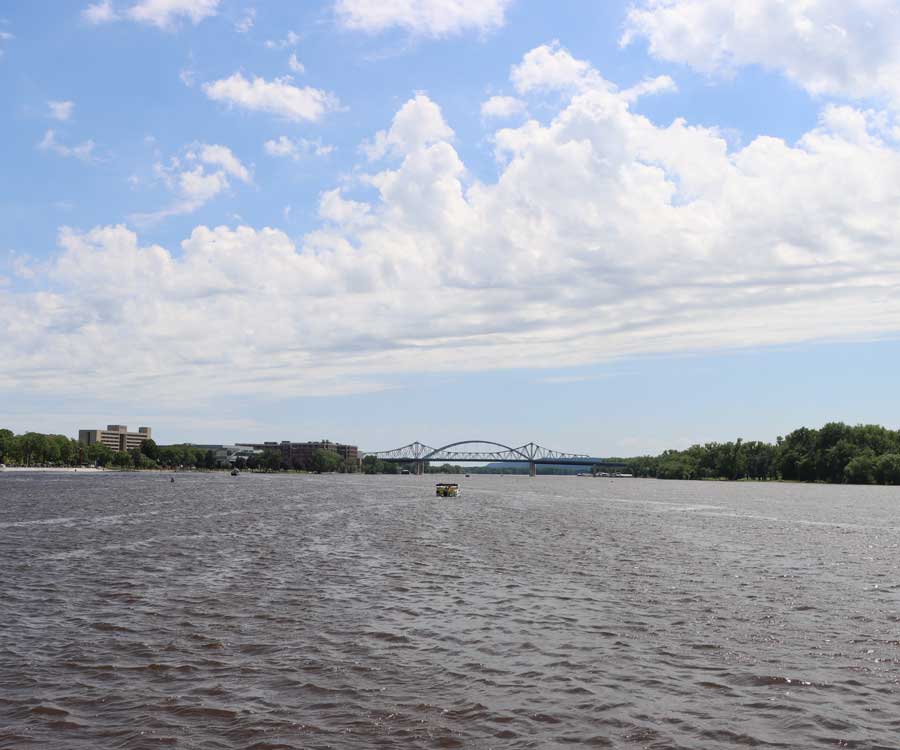
Find out how the working river impacts the surrounding states’ economy
Industries rely upon the Upper Mississippi River every day in surrounding states for jobs, recreation and transportation of goods and services, but the benefits can be easily forgotten for those who only see the river and not the economy that thrives because of it.
The Mississippi River is there. Steady and consistent. But do we really see it for what it does for us? As Upper Mississippi Waterway Association’s (UMWA) Cassandra Caldwell put it: “They’re not paying attention to the barges going by because it’s out of sight, it’s out of mind.”
Approximately 175 million tons of freight is moved on the Upper Mississippi River annually. Without it, around 8,000 additional semitrucks would travel on the road.
Caldwell is UMWA’s newly elected chairman who’s placing a high priority on promoting the economic vitality of the Upper Misssissippi River. She’s the government affairs manager of the Mississippi River & Tributaries with American Cruise Lines and conceived the idea to propose the regional economic impact study for the Upper Mississippi River navigation system. The regional economic impact study for the Upper Mississippi River navigation system is the first of its kind for this region.
Based on another study done on the Arkansas River, the University of Arkansas’s College of Engineering’s Maritime Transportation Research and Education Center will conduct the study through a federally funded grant.
The study’s core
The study will investigate the regional economic impacts of the Upper Mississippi River to inform waterway stakeholders of the navigation system’s value. The study will consider multiregional economic impacts from hydropower energy generation, U.S. Army Corps of Engineers Operation and Maintenance expenditures, private sector investment expenditures, port activities, shippers’ activities, transportation cost savings and recreational benefits related to the area.
It will show numbers on what the transportation impacts are, what commodities have the highest share of tonnage moving on the river, sales impacts and, more specifically, will highlight the largest contributors to those sales impacts like port activities, transportation cost savings, shippers’ activities or even recreation.
“It’ll have specific numbers for each of those contributors,” Caldwell said. “It really breaks it down, so you can put that quantitative value on what the system does and it’s not just going to do it overall for the Upper Mississippi, but it’s also going to break it down by individual states.”
Sales impact and employment impact will also be part of the research, including looking at what those largest contributors are such as the ports, transportation or recreation and how many total jobs nationwide the Upper Mississippi River provides with a state-by-state breakdown.
“It will give us specific numbers, which is helpful when telling the story, and it’s very impactful to our congressional delegation and to the public,” Caldwell said. “What better way to educate the public?”
The study is meant to bring attention to the overall impact the Upper Mississippi River brings to each of the states and the region.
“If it’s not holding up your commute, do people even notice the impact? … They don’t understand how significant the economic impact is of everything else that happens on our river,” Caldwell said. “It’s going to give us the ability to tell that story clearly, not just to our, congressional folks, but also to the general public at large.”
Another piece of the study is the ability to give information from business tax impacts. This portion aims to underscore the total business taxes that are contributed, broken down by contributors.
In Caldwell’s previous position as the executive director with the Arkansas Waterways Commission, her goal was to educate about the Arkansas river. Bringing her expertise to UMWA, Caldwell hopes to shine some light on the opportunities for careers within the industry, as well on the river.
“We’ve got to do a better job of educating people and getting the word out about how significant this is, because part of the problem that I’ve seen personally, is the most detrimental thing to us when it comes to funding our navigable waterways is the lack of human connection,” Caldwell said.
The study will make this connection to humanize what the Upper Mississippi River does for the region’s communities.
Another area the study will cover is showcasing the reality of how much tonnage is moving on the Upper Mississippi River and comparing the other various transportation modes like rail cars and semitrucks.
“This study will give us the data and research needed to show how the Upper Mississippi River impacts the communities and municipalities on the river,” UMWA Executive Director Gary Williams said. “It will also show the decision makers the influence the investment and support of the river has and how critical it is to sustain it as a viable working waterway.”